Pivot point vs. pivot span: what's the difference?
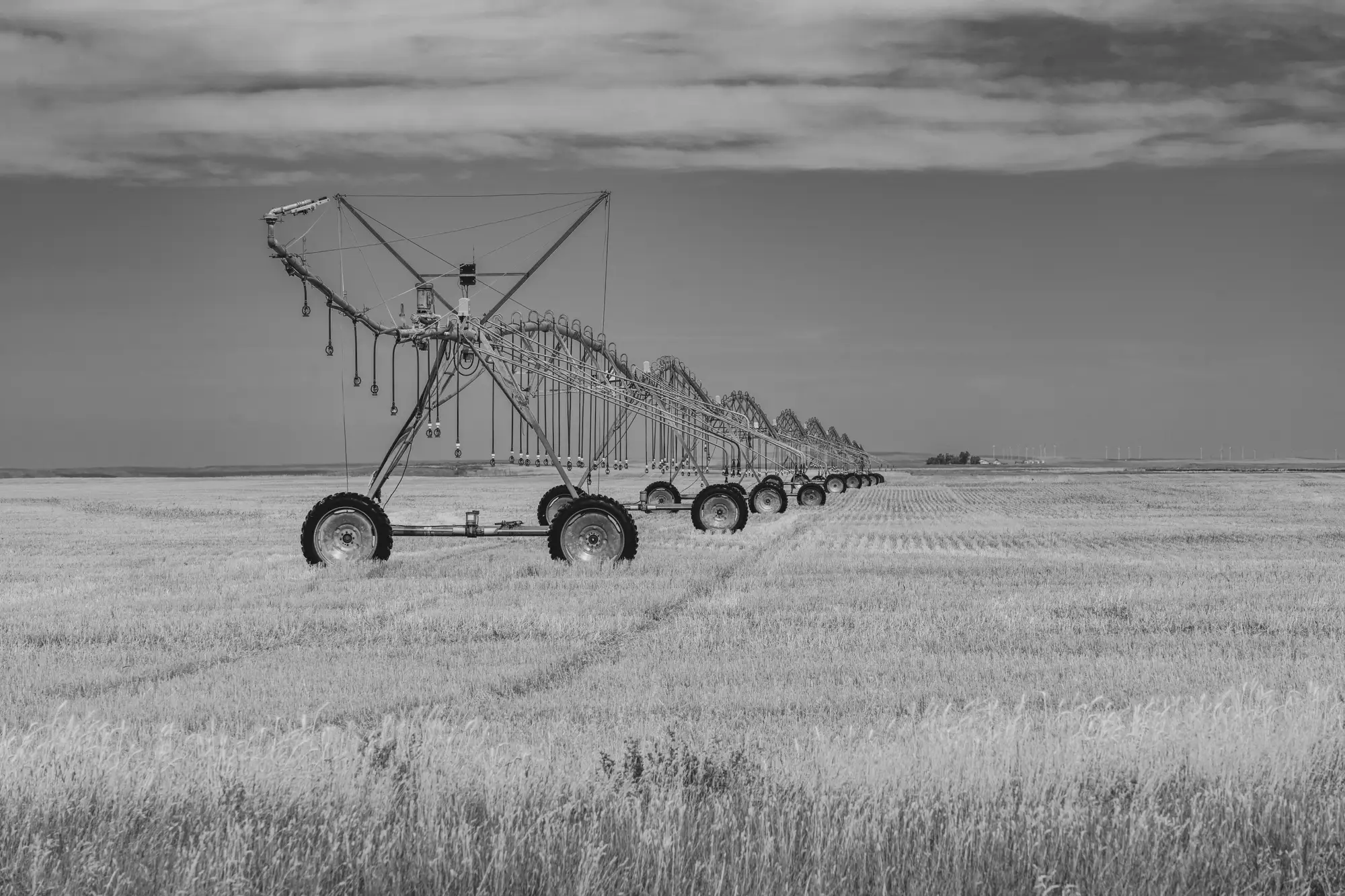
If you've spent any time on the radio with a new operator, you've probably had to untangle this one. Someone says "the pivot point is leaking" when they mean the tower at span three, or "check the span" when the actual trouble is at the center. The terms aren't interchangeable, and mixing them up costs time when you're trying to describe where a problem sits on the circuit.
The pivot point is the anchor, not the machine
The pivot point is the fixed location the whole system rotates around. It's the pad, the riser, the gearbox and the water supply connection, the one spot on the field that never moves. Everything else, every tower, every span of pipe, every drop and nozzle, sweeps around that point in a circle (or a partial circle, if you're running a wedge instead of a full 360).
Pull up the plat for a quarter section and the pivot point is usually dead center, which is why the irrigated area comes out as that familiar circle inscribed in a square. It's also the reference point for every sector on your report. When you're describing where in the circuit a dry spot shows up, you're measuring out from the pivot point in degrees and in distance, the same way you'd give a bearing and a range.
The pivot point matters for water rights too. Your district permit is usually tied to that fixed location and the acreage it serves, not to any individual tower or span. If someone moves the pivot point (relocating the pad after a field consolidation, say), that's a different conversation with the district than swapping out a gearbox.
Span vs. tower: the moving parts between the point and the end gun
A span is a section of pipe, usually somewhere between 90 and 250 feet depending on the make and the field layout, running between two towers. Each tower is the wheeled support that holds a span up and keeps it moving at the right speed to maintain the system's alignment. A typical quarter-section pivot runs six to eight spans; bigger systems run more.
When someone says "span three is dragging," they mean the stretch of pipe and drops running from tower three to tower four. When a nozzle on that span clogs or a drop hose kinks, the dry pattern on the ground shows up as an arc at that span's radius. That's the shape you're looking for on imagery: a dry band at a consistent distance from the pivot point, cutting across however many degrees the pivot traveled before someone noticed and shut it down, or before the rotation carried it clear around again.
The end gun is its own thing again, mounted at the last tower to throw water past the wheel track and square up the corners a circle would otherwise miss. A stuck end gun solenoid leaves a dry wedge at the outer edge of the circuit, a shape that reads differently from a mid-span nozzle problem or a pivot point issue, which usually shows up as a water or pressure problem affecting the whole field rather than one arc.
Why the distinction matters when you're reading a sector report
None of this is academic once you're trying to match a flagged sector back to a physical cause. A dry arc at a fixed radius points you to a span and the towers bracketing it. A problem that tracks with time of day or runs along the whole radius points you toward the pivot point itself, the pad, the gearbox, the main line pressure. Knowing which is which before you drive out saves a trip, or tells you which spare parts to load before you leave the shop.
Irrigation Monitor builds its weekly reports against each pivot's actual geometry, so a flagged sector comes back referenced to pivot point, span, and tower position the same way your own crew would describe it, instead of a generic coordinate. If you'd rather get that sector-by-sector read than drive the circuit looking for it, take a look at what the weekly report covers.